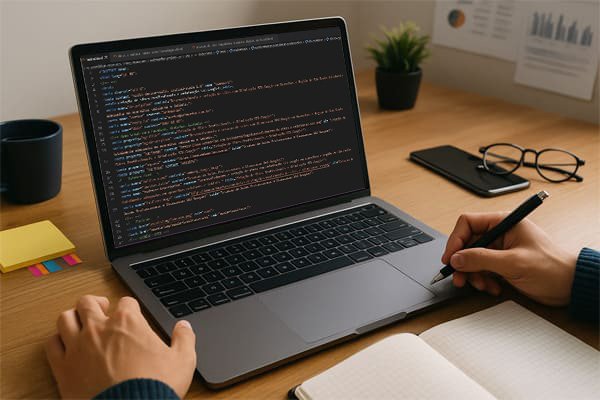


How to Plan a Professional Website with SEO from the Start

Planning SEO before development helps you correctly define pages, architecture, content, URLs, and technical structure, reducing rework after the website is already published.
SEO shouldn't only come into play once the website is finished. The most efficient time to make several important decisions is before layout and coding, when it's still possible to organize the architecture without having to fix pages, URLs, or content that's already published.
Good SEO website planning starts by defining what the business offers, which searches truly represent those services, which pages will be needed, and what role each URL will play. Only after this stage does it make sense to turn the strategy into a menu, layout, and development.
For a business planning to build a new website or replace an old structure, this order avoids a common problem: developing first and discovering later that the pages don't match the searches they were supposed to serve.
Should SEO be planned before building the website?
Yes. SEO planning should begin before development because several ranking decisions directly affect the website's structure.
If the developer only receives a generic list of pages like "Home," "About," "Services," and "Contact," an important part of the architecture is already being decided without considering search intent.
Imagine a business that offers five different services. Putting all of them on a single page may seem simpler visually, but it can limit each service's ability to have its own context, content, and intent.
In other cases, the opposite problem happens: several nearly identical pages are created just to try to target small keyword variations. This increases the risk of overlap and cannibalization.
The role of planning is to find the balance.
For businesses that want to integrate structure, development, and rankings from the start of the project, professional website design can start from this logic instead of treating SEO as a separate step after launch.
What needs to be defined before designing the website's menu?
Before building the menu, you need to define services, audiences, search intent, and the pages needed to represent each important topic.
The menu should reflect an architecture that's already been thought through, not define the architecture on its own.
A safer sequence is:
- identify the main services or solutions;
- understand how the audience searches for those solutions;
- group searches that represent the same intent;
- separate intents that justify their own pages;
- organize the hierarchy of those pages;
- only then structure the menu and navigation.
For example, if two services address clearly different problems and searches, a single generic page may not be enough. On the other hand, if two keywords represent exactly the same need, creating a separate URL for each term tends to create redundancy.
The most important criterion isn't how many keywords exist. It's how many different intents need to be addressed.
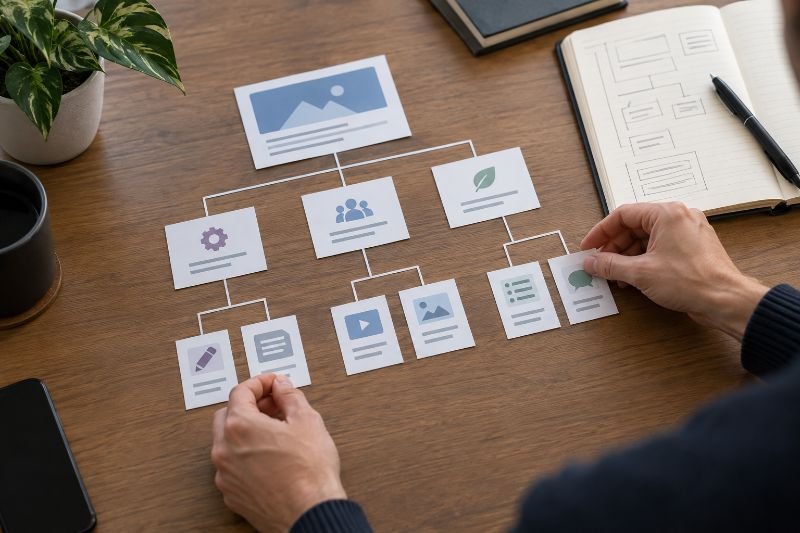
Images created with AI for illustration purposes only
Does every page need one main intent?
Yes. Each important page should have a clear enough function and dominant intent so it doesn't unnecessarily compete with other URLs on the same website.
This doesn't mean a page can only show up for one keyword.
A good page can answer many variations, questions, and semantically related terms. What needs to be clear is the central topic.
For example:
| Page | Dominant Intent |
|---|---|
| Home | Introduce the business and main solutions |
| Service A | Explain and present Service A |
| Service B | Explain and present Service B |
| About | Show institutional context |
| Article | Answer a specific informational question |
This separation helps both users and search engines understand which URL is best suited for each context.
The table also shows why creating pages just for very close keyword variations isn't a good strategy. Architecture should come from intent and business needs, not from the number of terms found in a tool.
How do you avoid cannibalization even before publishing the website?
The best way to prevent cannibalization is to define in advance which intent belongs to each URL and avoid creating different pages to answer essentially the same search.
Prevention starts as early as the spreadsheet or sitemap stage.
For each planned page, it's worth recording:
- URL;
- main topic;
- commercial or informational goal;
- search intent;
- main keyword;
- semantic variations;
- parent page in the hierarchy;
- pages that will receive links;
- potentially competing pages.
When two URLs seem to serve the same function, that's the moment to revisit the architecture — not after both are already indexed.
It's also important not to confuse topical depth with page multiplication. A single strong piece of content can answer several related sub-questions without needing a separate URL for every searched phrase.
To understand what happens after the website is live and starts competing for rankings, it's also worth reading about how to get your website on Google's first page.

Should content be created before or after the layout?
Main content should be defined before or during the layout, because the real information needs to guide the page's visual structure.
Designing the whole layout with placeholder text and trying to fit the content in afterward can cause problems.
A service page may need:
- initial explanation;
- benefits;
- applications;
- differentiators;
- process;
- frequently asked questions;
- proof of experience;
- CTA;
- related content.
If the layout was designed for two small text boxes, but the page needs to explain a complex technical service, the project is already born in conflict.
The opposite also happens. Overly long layouts can lead to writing text just to fill space.
Design and content need to work together.
This point also affects trust. A trustworthy institutional website needs to organize the information visitors actually use to evaluate the business, not just present a nice-looking visual composition.
Which SEO elements should be planned during development?
Development should implement, from the start, a crawlable, fast, responsive, and semantically organized foundation.
Points worth paying attention to include:
- HTML with a coherent hierarchy;
- a single H1 when appropriate for the structure;
- H2s and H3s organized semantically;
- clean URLs;
- titles and descriptions prepared in advance;
- consistent canonical tags;
- properly sized and optimized images;
- useful ALT attributes;
- responsiveness;
- performance;
- clear navigation;
- internal links;
- sitemap;
- robots.txt;
- error pages;
- redirects when the new website replaces old URLs;
- structured data that matches the real content.
Not all of these elements carry the same weight or require the same setup on every project. What matters is avoiding basic decisions being needlessly left for later.
When SEO is part of development, SEO optimization work builds on a more organized foundation, instead of having to rebuild structural problems that could have been prevented.

Images created with AI for illustration purposes only
How do you plan internal links before publishing?
Internal links should follow the architecture and connect pages that have a real relationship of topic, hierarchy, or user journey.
You don't need to wait months to start thinking about interlinking.
If the new website will have:
- a main service page;
- sub-services;
- related articles;
- an institutional page;
- supporting content;
these relationships can be planned as early as the architecture stage.
A service page can point to an article that addresses an objection. The article can send context back to the commercial page. A higher-level page can distribute access to specific services.
This flow helps users find the next relevant content and reinforces the semantic relationship between pages.
The main thing to watch is not turning internal links into mechanical repetition of the same anchor text. Anchors should describe the destination naturally.
Do performance and mobile need to be part of initial planning?
Yes. Performance and mobile experience should be part of development decisions, because fixing a heavy structure later tends to be more work than avoiding the problem in the first place.
This involves choices like:
- image size and format;
- number of scripts;
- libraries used;
- font loading;
- visual components;
- CSS structure;
- menu behavior;
- button size;
- readability;
- layout stability.
A website can be visually sophisticated without needing to sacrifice experience.
That's why performance shouldn't be treated only as an optimization task done at the end. It's also a consequence of the choices made throughout the project.
What should you review before publishing the website?
Before publishing, it's best to run an editorial, technical, and navigation review to confirm the planned structure was actually implemented.
A pre-launch checklist can verify:
Content
- correct H1;
- organized headings;
- final copy;
- CTAs;
- spelling;
- internal links;
- institutional information.
Indexing
- meta robots;
- canonical;
- robots.txt;
- sitemap;
- correct URLs.
Migration
When there's a previous website:
- old URLs mapped;
- necessary redirects;
- important content preserved;
- broken links reviewed.
Experience
- mobile functionality;
- forms;
- WhatsApp;
- menus;
- buttons;
- images;
- perceived speed.
Post-launch
- Search Console setup or review;
- sitemap submission or verification;
- indexing follow-up;
- validation of important pages.
This review prevents small launch mistakes from turning into silent problems for weeks or months.

Images created with AI for illustration purposes only
Should SEO only think about Google, or also about conversion?
SEO needs to attract the right person, but the website also needs to help that person understand the offer and move forward in their decision.
A project shouldn't chase traffic in isolation.
If a page shows up for relevant searches but presents a service confusingly, hides contact options, or fails to build trust, part of the potential earned in search gets lost after the click.
That's why website planning with SEO also needs to consider:
- clarity of the offer;
- navigation;
- how services are presented;
- proof of legitimacy;
- content;
- CTAs;
- mobile experience;
- continuity of the journey.
SEO gets the user to the page. The page needs to do its part after that.
When is it worth involving an SEO specialist before development?
Specialized support makes the most sense when the website will have multiple services, a goal of organic growth, URL migration, or a risk of overlap between pages.
Simple projects also benefit from planning, but the need grows as the architecture becomes more complex.
An analysis before development can help answer:
- which pages to create;
- which pages not to create;
- which term belongs to which URL;
- how to structure the services;
- which content needs to exist;
- how to preserve old URLs;
- where to place internal links;
- which technical elements need to be part of development.
This is different work from trying to fix the project after everything has already been decided.
When there are doubts about architecture or overlap, SEO consulting for businesses can also help organize these decisions before they turn into rework.
Planning first is more efficient than fixing things later
A professional website prepared for SEO isn't born from a sequence where you design first, then code, and only at the end does someone "add SEO."
The more coherent sequence is:
goal → audience → search intent → architecture → pages → content → layout → development → validation → publishing → monitoring
This order doesn't mean making the project more bureaucratic. It means making decisions at the point when they're easiest to adjust.
When SEO comes in early, architecture, content, and development start working in the same direction.
For businesses about to build or redesign their website, this is the main takeaway: don't wait until launch to find out how Google and users are supposed to understand your pages.
Building or redesigning your website?
WebMARFAN has worked with website development and SEO since 2007, making it possible to consider structure, content, and rankings as early as the planning stage.
Talk to WebMARFAN and find out how to structure your new website before development begins.