
Your Website Shows Up on Google But Isn't Generating Leads? Here's What's Missing

You invest time, maybe money, and your website finally shows up on Google. Visits start coming in. But the phone doesn't ring, the form stays empty, and WhatsApp stays silent.
This scenario is more common than it seems, especially among small and mid-sized businesses in Guarulhos and Greater São Paulo. And the cause is rarely SEO itself. In most cases, the problem lies in what happens after the user clicks through and lands on the website.
This article explains why a well-ranked website may not generate leads, the most common causes of that problem, and what needs to be adjusted in both SEO and website structure so visits start turning into real contacts.
Traffic isn't the same as a contact
That distinction seems obvious, but it's where many businesses lose their way. When a website starts showing up on Google, the sense of accomplishment is real. Organic rankings are, in fact, an important result. The problem is treating traffic as the destination when it's actually just the path.
What separates a visit from a qualified lead
A visit is anyone who lands on the website. A qualified lead is someone who arrived with a real need, found what they were looking for, and took a step toward making contact.
Between the visit and the lead, there's a journey. And it's within that journey, inside the website itself, that most businesses lose the user. Slow speed, confusing navigation, an unclear value proposition, or the lack of a visible contact button are enough to make the user close the tab and look for another business.
Why ranking well on Google doesn't guarantee the contact
Google delivers the user to your website's door. What happens next depends entirely on what they find inside. If the page doesn't quickly answer the searcher's intent, if the value proposition isn't clear within the first few seconds, or if there's no obvious path to contact, the visitor leaves without a trace.
SEO without conversion is only half the job. It solves visibility, but it doesn't solve the decision.
The most common causes of a website that doesn't convert
There's a recurring set of problems in the websites of businesses that show up on Google but don't get contacts. Identifying which ones apply to your case is already the first step toward fixing it.
Images created with AI for illustration purposes only
Lack of a clear, well-placed CTA
The call to action is the element that tells the user what to do next. When it doesn't exist, is poorly written, or is hidden in the footer, the visitor simply doesn't act. Not because they don't want to, but because they didn't get clear direction.
An effective CTA appears at more than one strategic point on the page, uses benefit-driven language, and reduces contact friction as much as possible. "Request a free, no-obligation quote" converts better than "Contact us," because it points to the next step more clearly.
Generic or invisible value proposition
When a user lands on the website, they need to understand within seconds what the business does, who it serves, and why they should choose it. If the answer isn't clear right at the top of the page, the visitor won't scroll to find it. They'll leave.
"Complete solutions for your business" doesn't say anything. A real value proposition is specific, direct, and connected to the need of whoever is searching.
Lack of social proof
Reviews, testimonials, and examples of completed work act as a trust filter. For local businesses in Guarulhos and São Paulo, this factor carries even more weight: the user wants to know whether other business owners in the region have already trusted this business, and what they thought.
The absence of any social proof, or the presence of generic, unidentified testimonials, creates silent distrust. The visitor leaves with no contact and no explanation.
Speed and responsiveness hurting the experience
A slow website, or one that doesn't work well on mobile, loses the user before even showing the content. Most visits today happen on mobile devices, and Google uses mobile experience as a ranking factor through Core Web Vitals.
If a website takes more than three seconds to load on a phone, a significant share of visitors will close it before seeing anything at all. This problem hurts both SEO and conversion at the same time.
A hard-to-find form or WhatsApp button
The user decided to reach out. But the WhatsApp button isn't visible, the form is three scrolls down the page, or the only available channel is an email that rarely gets a quick response.
Every extra click the user needs to make to get to the contact point is a chance for them to give up. The path between intent and contact needs to be as short and direct as possible.

The role of on-page SEO in conversion
On-page SEO isn't just there to help Google understand the website's content. It also sets the user's expectation before they even click. When that expectation isn't met on the page, the result is an immediate bounce, and that signal gets picked up by the algorithm.
When the title promises one thing and the page delivers another
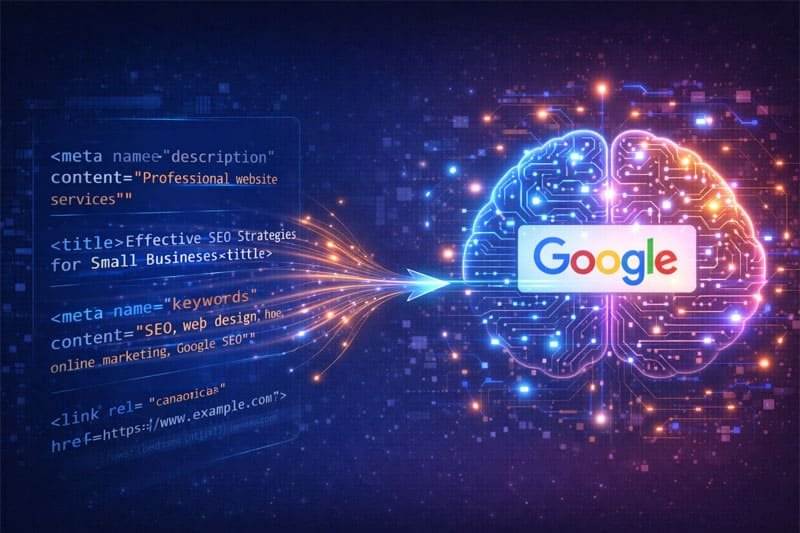
The meta title and meta description are what the user reads on Google before deciding to click. If these elements create an expectation the page doesn't meet, the visitor lands, doesn't find what they expected, and leaves within seconds.
This behavior, known as a high bounce rate, hurts both conversion and rankings. Google interprets a quick exit as a sign that the content wasn't relevant to that search.
How the H1 and meta description affect the decision to make contact
The H1 is the first confirmation the visitor gets that they've landed in the right place. It needs to align with what was promised in the title shown on Google and with the searcher's need.
When the H1 is generic, decorative, or just the business name with no context, the user doesn't feel like they found what they were looking for. The result is an exit with no contact.
The right approach is to work on-page SEO with a focus on optimizing every element of the page, thinking about the user's journey end to end, from the moment they see the result on Google to the moment they decide to make contact.
How a well-crafted CTA changes a website's results
The call to action is the most underrated element in the structure of small and mid-sized business websites. Many pages have CTAs, but few have CTAs that actually work. The difference lies in the details of placement, language, and context.
Where to place the CTA on the website
An effective CTA doesn't appear only at the end of the page. It needs to show up at at least three strategic moments: right above the fold, at the end of each relevant content block, and at the end of the page.
On service websites, a fixed WhatsApp button on the side or bottom of the screen is a simple feature that increases access to contact without depending on the user scrolling.
How to write a call to action that works
A good CTA has three traits: it's specific, benefit-driven, and reduces the user's perceived risk.
| Generic CTA | Result-Driven CTA |
|---|---|
| Contact us | Request a free, no-obligation quote |
| Get in touch | Talk to a specialist now |
| Learn more | See how we can help your business |
| Click here | Request a free assessment of your website |
The CTA's language needs to match the user's stage. Someone at the start of their research responds better to educational CTAs. Someone who's already deciding needs a direct CTA, with low friction and clarity about the next step.
SEO and website structure need to work together
Treating SEO and website structure as separate projects is one of the most common mistakes among businesses investing in a digital presence. Neither replaces the other, and both need to be aligned from the start for results to show up.
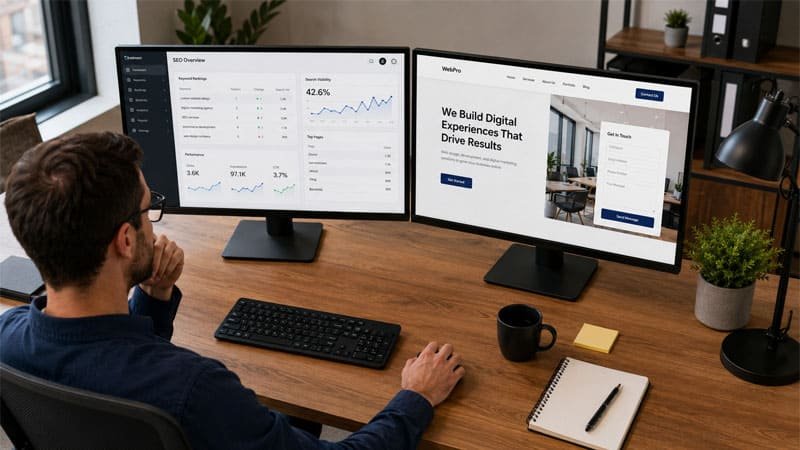
Images created with AI for illustration purposes only
What happens when one exists without the other
A well-structured website, with a clear CTA and a defined value proposition but no SEO, simply isn't found. The conversion work has no audience to work on.
A website with well-executed SEO that ranks at the top of Google, but without a conversion-oriented structure, attracts visitors who leave without contacting. The ranking work never turns into a business result.
That's exactly the relationship between SEO and strategic content: visibility and conversion need to move together for the website to work as a real channel for generating opportunities.
How to integrate SEO and conversion from the moment the website is built
When a website is planned with SEO and conversion integrated from the start, every structural decision already considers both goals. Heading hierarchy serves Google as well as guiding the user. Speed serves rankings as well as keeping visitors on the page. The value proposition serves semantic relevance as well as the decision to make contact.
This is the model WebMARFAN has applied since 2007 in professional website design projects for businesses in Guarulhos and the São Paulo region. Almost two decades in a market segment that has changed completely several times demand constant updating, which is why practices like E-E-A-T, AEO, and GEO are already part of the process behind every project delivered.
What to check before concluding your website needs to be rebuilt
The solution isn't always a brand-new website. In many cases, strategic adjustments to the existing structure already solve most of the problem. Before making a decision, it's worth checking:
| What to Check | Warning Sign |
|---|---|
| Mobile load speed | More than 3 seconds to load |
| CTA visible without scrolling | Missing or generic |
| Value proposition above the fold | Missing or confusing |
| Social proof on the page | Missing or without real identification |
| Accessible WhatsApp button or form | Hard to find |
| H1 aligned with what the user searched for | Generic or disconnected |
| Meta description consistent with the content | Missing or unappealing |
If most of these points show a problem, restructuring the website may be more effective than isolated fixes. If only a few points need correction, targeted optimizations alone can already produce results.
For businesses that also want to expand their local presence, it's worth checking whether your Google Business Profile is complete and optimized. A well-configured profile complements the website in generating contacts, especially in searches made by people near your area.
Frequently Asked Questions About Websites That Don't Generate Leads
Why does my website show up on Google but I still don't get contacts?
Showing up on Google solves the visibility problem, not the conversion one. If the website doesn't have a clear value proposition, a well-placed CTA, social proof, and a good mobile experience, the visitor comes in and leaves without contacting you. Rankings bring the user to the website; the page's structure is what turns that visit into a real contact.
What is a CTA, and why does it influence lead generation?
CTA stands for call to action: the element that shows the visitor their next step. It can be a WhatsApp button, a form, or a link to request a quote. When the CTA is missing, poorly placed, or written generically, the user doesn't act, even if they're interested in the service. An effective CTA is specific, visible, and focused on the reader's benefit.
Does SEO guarantee that a website will generate contacts?
Not on its own. SEO makes sure the website is found by people with search intent related to your service. Lead generation depends on what the user finds inside the website: value proposition, social proof, speed, responsiveness, and strategic CTAs. SEO and conversion structure need to work together.
What's the difference between organic traffic and a qualified lead?
Organic traffic is the volume of visits that reach the website through Google searches, with no paid ads. A qualified lead is a visitor who arrived with a real need, recognized value in what the website presented, and took a step toward contact. Not all organic traffic generates leads, and it's precisely the website's structure that determines which portion of the traffic converts.
How can I tell whether the problem is in my SEO or my website structure?
If the website gets few visits and doesn't generate contacts, the problem is probably in the SEO. If the website gets visits but doesn't generate contacts, the problem is in the structure and conversion strategy. In many cases, both need to be adjusted at the same time, since on-page SEO and page structure are parts of the same project.
Does website speed really influence lead generation?
Yes. A slow website loses the visitor before it even shows any content. Google uses speed and user-experience metrics, the Core Web Vitals, as a ranking factor. A website that loads well on mobile keeps more users, lowers the bounce rate, and increases the odds of contact.
Ready to turn visits into real contacts?
If your website shows up on Google but the phone doesn't ring, the problem has a solution. WebMARFAN works with professional website design and SEO optimization integrated from day one, precisely so visibility and conversion move together from the start.
With almost 20 years of experience on projects for businesses in Guarulhos and the São Paulo region, the work is done by someone who understands both sides: ranking on Google and the structure that turns visitors into customers.
Talk directly to a specialist on WhatsApp and find out what's holding your website back.
Ready to turn your website into an authority Google AI can cite? Count on WebMARFAN's experience to guide your strategy toward organic leadership.