
What an Institutional Website Needs to Build Trust

If the question is what an institutional website needs to have to build real trust, the answer starts with something simple: it needs to make the visitor quickly understand who the business is, what it does, why it seems credible, and how to get in touch without friction. When that doesn't happen, even a good business can come across as insecure, improvised, or unprofessional.
This topic matters because many businesses still treat their institutional website as just something "to have a presence." In practice, though, it works as a storefront for credibility. Before reaching out on WhatsApp, requesting a quote, or comparing providers, a lot of people go through the website to sense whether the business feels trustworthy. This article is meant for business owners and service providers who want to understand what actually shapes that perception, without falling into superficial formulas.
Why an institutional website has such an influence on trust
The institutional website is often one of the first points of contact between a business and someone who doesn't know it yet. Within seconds, the visitor forms an impression. If the website looks confusing, incomplete, outdated, or inconsistent, that perception can spill over onto how the whole business is seen.
That doesn't mean the customer consciously thinks, "this website is bad." Often, they just feel less confident and leave. That's the kind of silent loss that happens before contact even occurs.
Digital trust is built through signals
An institutional website for businesses builds trust when it delivers consistent signals of professionalism. Those signals don't depend only on design. They show up in the clarity of the message, the organization of the navigation, the quality of the copy, visual consistency, the presence of real information, and how easy it is to understand the next step.
When a business gets this right, the website helps reduce uncertainty. When it gets this wrong, it adds friction.
What an institutional website needs to have in practice
Saying a website needs to "look nice and professional" doesn't help much. What actually matters is understanding the elements that make a visitor trust it.
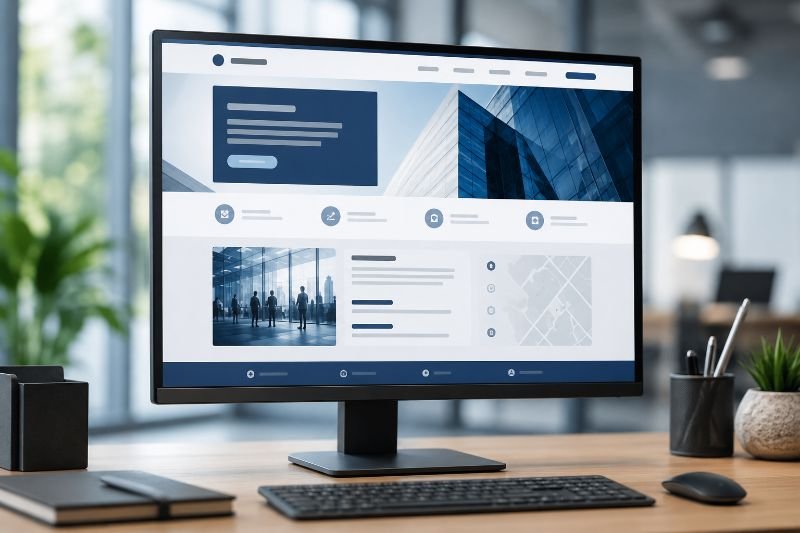
Images created with AI for illustration purposes only
Clarity about who the business is and what it does
One of the most common mistakes is making the visitor decipher the business. The website needs to make clear, right from the start, what the business does, who it serves, and what kind of solution it offers.
When this stays vague, trust drops. The visitor feels the business couldn't even explain its own value proposition.
Coherent institutional presentation
A good institutional website needs to show there's a real business behind the page. That comes through information about what the business does, its location, experience, service context, and real ways to get in touch.
At WebMARFAN, for example, the website's current structure reinforces institutional presence with service pages, contact information, an address in Guarulhos, a portfolio, testimonials, and a clear positioning around website design and SEO. This kind of composition helps strengthen the perception of a legitimate business.
Simple, logical navigation
When a user lands on a website and doesn't know where to go, the experience breaks down. Clear navigation is a sign of maturity. Visitors need to be able to find services, contact information, a portfolio, an about section, and key information without effort.
Visuals consistent with the business's proposal
Trust isn't the same as being impressed. An overly busy, confusing, or visually inconsistent website can come across as less serious than a simple, well-executed layout. The goal of the visuals should be to reinforce clarity, not compete with the message.
Practical table: what builds trust and what drives visitors away
| Website Element | Helps Build Trust | Weakens Trust |
|---|---|---|
| Opening message | Clearly explains what the business does | Vague, generic phrases |
| Institutional information | Shows a real, accessible business | Missing context and basic details |
| Navigation | Is simple and predictable | Confuses and hinders the next step |
| Content | Answers real questions | Feels shallow or improvised |
| Visuals | Are consistent and professional | Are cluttered, outdated, or inconsistent |
| Contact | Is easy to find | Is hidden or incomplete |
Website content also affects trust
A lot of people think of trust as purely a visual matter. But copy carries enormous weight here. A website with generic text, exaggerated promises, or shallow explanations conveys less credibility.
Good copy isn't the prettiest — it's the most useful
When a visitor lands on a page, they want to quickly understand whether that business seems credible, knows what it's doing, and is worth contacting. Content helps with this when it answers real questions, explains the service without padding, and shows confidence without exaggeration.
That's exactly why many businesses see value in a more professional digital presence structure, including support from professional website design, once they understand the website needs to communicate more than just "being online."
Generic content weakens positioning
Phrases like "quality, innovation, and commitment" don't accomplish anything on their own. If the website uses that kind of language without explaining what it means in practice, it loses force. Users don't just want a slogan. They want straightforward reading and criteria to build trust on.
Proof of legitimacy that helps a lot
Not every business has a famous case study or dozens of public reviews. But it's still possible to build legitimacy honestly.
Elements that tend to help
- real contact information
- an address when it makes sense
- a portfolio or work examples
- an about page with genuine context
- authentic testimonials, when they exist
- well-structured service pages
- consistency between the website and external channels
When these elements show up naturally, the website stops looking like an improvised page.

Common mistakes that make an institutional website lose credibility
Many businesses have good services, but their website weakens that perception.

Images created with AI for illustration purposes only
A website that looks unfinished
Empty pages, broken sections, overly short copy, or images with no context convey carelessness.
Too much effect, not enough substance
A flashy visual doesn't make up for a lack of clarity. In many cases, it even gets in the way.
Lack of information hierarchy
When everything looks equally important, the visitor doesn't know what to prioritize.
An overly sales-y tone
Trust doesn't grow through pressure. It grows through clarity, objectivity, and consistency.
A website out of step with search and rankings
If a business wants to be found and seen as a reference, its website also needs to be at least somewhat aligned with SEO, information architecture, and search intent. That's why it's worth reading more about the importance of an SEO specialist for your website, especially when the goal is to combine credibility with visibility.
What small businesses should prioritize first
Not every business needs to start with a huge website. But almost every business needs to start with a clear one.
Top priorities at the start
- a clear value proposition right at the top
- well-explained services or solutions
- a consistent visual identity
- visible contact information
- a consistent about page
- good mobile navigation
- content free of empty promises
These points alone already change a lot about how the business is perceived.
A trustworthy website isn't the flashiest — it's the most coherent
In practice, digital trust comes from the sum of form and content. A strong institutional website is one that feels trustworthy because it makes sense as a whole. It doesn't try to impress at any cost. It organizes information well, supports the business's image, and helps the visitor make a decision with more confidence.
This coherence also helps organic performance, because clearer, better-structured, more useful websites tend to work better with Google and with new search experiences. That's why thinking of an institutional website and rankings as separate things no longer makes much sense. This also ties into SEO optimization for businesses when the goal is to strengthen perception and visibility at the same time.
What to do now if your website doesn't convey the trust it should
The first step is to look at the website with less attachment and more honesty. Does someone who doesn't know your business quickly understand what you do? Can they easily find contact information? Do they sense organization? Do they feel secure while browsing? Can they identify real signs of professionalism?
If the answer isn't clearly positive, there's probably room to improve. In many cases, the problem isn't "having a website or not," but having a website that doesn't back up the business's real quality.
This is where WebMARFAN steps in with a consultative approach, helping businesses build a more coherent, clear digital presence prepared to convey real trust.

Images created with AI for illustration purposes only
Frequently Asked Questions About Institutional Websites and Trust
Can a simple institutional website build trust?
Yes. As long as it's clear, coherent, well organized, and conveys real professionalism. Well-executed simplicity usually works better than an excess of elements with no direction.
Does the website's visuals alone solve the trust question?
No. Visuals help, but trust also depends on the content, the navigation, the institutional information, and the overall coherence of the experience.
Do I need to show an address and phone number on the website?
It depends on the type of business, but in many cases it helps a lot with legitimacy. What matters most is that there are real, visible ways to get in touch.
Are testimonials mandatory?
No. They help when they're genuine, but they're not the only path. A portfolio, clarity, good content, and consistent information also build trust.
When is it worth redesigning your institutional website?
When it doesn't explain the business well, looks outdated, creates uncertainty, or doesn't represent the business's real quality. In these cases, a redesign tends to be more strategic than just cosmetic.
If you want to understand how to structure a professional institutional website that better represents your business and conveys more confidence to visitors, talk to WebMARFAN and find out how to build an institutional website that conveys more trust for your business.